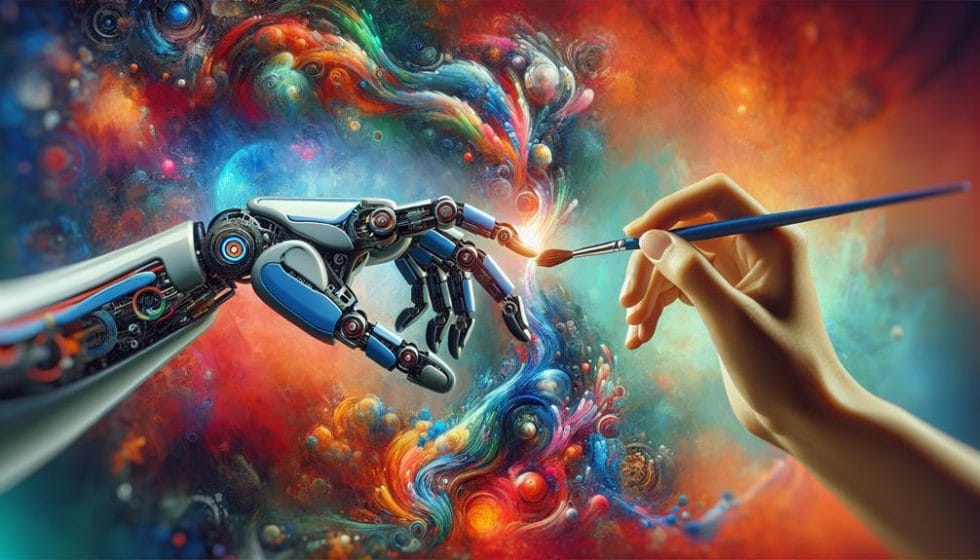
It feels like a battle for the ages: the logical precision of artificial intelligence against the unpredictable spark of human creativity. We see AI generating stunning art, writing poetry, and composing music, leading many to wonder if human creators are becoming obsolete. But is it really a competition? This question isn’t about picking a winner. Instead, it’s about understanding what each brings to the table and how they can work together.
This post will explore the unique strengths of both AI and human creativity. We will look at where AI shines, what makes human ingenuity irreplaceable, and how the future of creation lies in collaboration, not competition.
The Power of AI in the Creative Process
Artificial intelligence is a master of patterns and data. It can analyze millions of data points in seconds, a feat no human could ever match. This ability gives AI a powerful edge in specific creative tasks.
Speed and Scale: Creating at an Unprecedented Pace
One of AI’s most significant advantages is its ability to generate content at incredible speed and scale. Imagine needing a dozen variations of a logo, hundreds of product descriptions, or background music for a video game. An AI can produce these assets in minutes, freeing up human creators from repetitive and time-consuming tasks.
For example, marketing teams use AI to generate multiple ad copy versions to test which one performs best. This process, which once took days of brainstorming and writing, can now be done almost instantly. This efficiency allows teams to focus their energy on strategy and more complex creative challenges.
Uncovering New Possibilities from Data
AI doesn’t just replicate; it can also innovate by identifying patterns we might miss. By training on vast datasets of existing art, music, or text, AI models can learn the underlying rules and styles of a genre. They can then use this knowledge to create something entirely new that still fits within that style.
Think of AI-powered music composition tools. They can analyze thousands of classical symphonies and then generate a new piece that sounds like it could have been written by a Baroque master. It’s not just copying notes; it’s understanding the very structure of the music and using it as a building block for something novel.
The Irreplaceable Spark of Human Creativity
While AI is a powerful tool, it has fundamental limitations. Human creativity is rooted in experiences, emotions, and a deep understanding of the world that machines currently lack.
The Role of Lived Experience and Emotion
True creativity often comes from a place of personal experience. A songwriter channels heartbreak into a powerful ballad. A novelist draws on their childhood memories to build a rich, believable world. A painter uses their feelings about a political event to create a thought-provoking masterpiece. These creations resonate with us because they are infused with genuine human emotion.
AI can simulate emotion based on the data it’s been fed, but it can’t feel it. It doesn’t know the joy of a first love, the pain of loss, or the quiet wonder of watching a sunset. This emotional depth is what connects an audience to a piece of art on a profound level, making it memorable and meaningful. The story behind the creation is often as important as the creation itself.
Context, Nuance, and Breaking the Rules
Humans understand the world in a way AI cannot. We grasp subtle social cues, cultural context, and irony. This understanding allows us to create work that is not only beautiful or interesting but also relevant and impactful. A stand-up comedian’s joke lands because they understand the shared experiences of the audience. A film director uses a specific camera angle to create a sense of unease that is culturally understood.
Furthermore, some of the greatest creative leaps in history have come from intentionally breaking the rules. Artists like Picasso shattered conventions of perspective, and musicians like The Beatles redefined pop music. This kind of revolutionary thinking comes from a desire to challenge the status quo, a motivation that AI, designed to follow patterns, doesn’t possess. Humans create with intent and purpose, often to make a statement or push boundaries.
Better Together: The Collaborative Future
The most exciting prospect isn’t AI versus human creativity, but AI and human creativity. When we view AI as a sophisticated tool rather than a competitor, we unlock a new world of possibilities.
AI as the Ultimate Assistant
In this collaborative model, AI handles the heavy lifting while the human provides the vision and direction. A graphic designer could use an AI image generator to quickly create dozens of initial concepts for a project. Instead of spending hours sketching, the designer can review the AI’s output, select the most promising ideas, and then use their expertise to refine and perfect them.
Similarly, a writer might use an AI to brainstorm plot points for a novel or overcome writer’s block. The AI can provide a foundation, but the writer weaves in the nuanced characters, emotional arcs, and unique voice that bring the story to life. In these scenarios, AI accelerates the creative process, allowing humans to focus on the high-level, strategic elements that require their unique skills.
Pushing the Boundaries of Art
Collaboration can also lead to entirely new forms of art. Artists are already experimenting with AI to create interactive installations that respond to viewers, or generative art that evolves over time. By partnering with AI, creators can explore ideas that were previously technically impossible. The human brings the conceptual vision, and the AI provides the computational power to execute it. This partnership isn’t about replacing the artist; it’s about expanding their toolkit.
Conclusion: A Partnership, Not a Rivalry
So, who wins in the showdown between AI and human creativity? The answer is clear: everyone does, as long as we treat it as a partnership. AI offers incredible efficiency, data-driven insights, and the ability to generate ideas at scale. Humans bring emotion, lived experience, contextual understanding, and the vision to break new ground.
The future of creativity is not about choosing one over the other. It’s about harnessing the strengths of both. By embracing AI as a powerful collaborator, we can augment our own creative abilities, streamline our workflows, and unlock new artistic frontiers. The human touch—the story, the emotion, the intent—will always be the heart of great work. AI is simply a new and powerful tool to help us bring that heart to the world.